

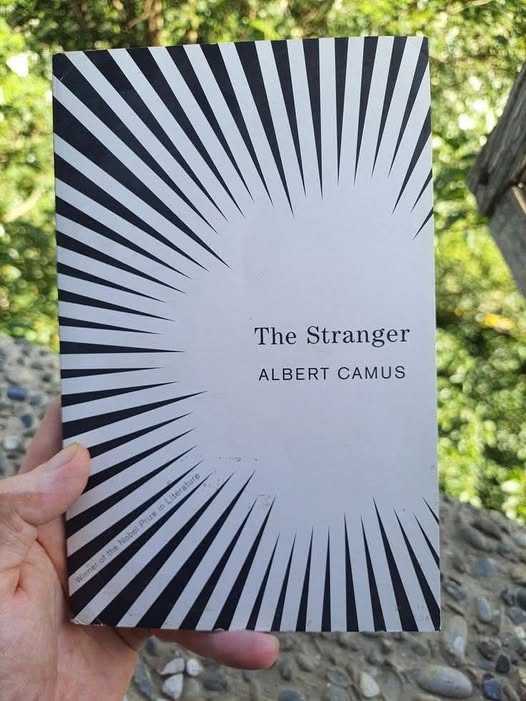
Albert Camus’ The Stranger stands as a central work of existential and absurdist literature, exploring the emotional detachment and moral ambiguity of its protagonist, Meursault. What makes the novel critically striking is not the plot itself—simple and linear—but the unsettling way in which Meursault’s indifference challenges social expectations about meaning, morality, and human connection.
Meursault’s lack of emotional response, particularly to his mother’s death, functions as a provocation against societal norms. His crime—the shooting of an unnamed Arab—is less significant in court than his unconventional reactions, suggesting that society fears nonconformity more than violence. This inversion allows Camus to critique the mechanisms through which judgment, identity, and morality are constructed.
Stylistically, the prose is sparse, direct, and stripped of sentiment, reflecting the protagonist’s inner world. Camus employs a detached narrative voice that forces readers into an uncomfortable proximity with Meursault’s perspective, raising the question of whether he is a victim of circumstance or a symbol of existential authenticity. The novel’s second half intensifies this tension, as Meursault confronts the arbitrariness of life and embraces the absurd—rejecting religious consolation and accepting the inevitability of death.
However, the novel is not without criticism. Some contemporary readings highlight its racial and colonial context, questioning the anonymity and erasure of the Arab victim. From this angle, the novel reflects a Eurocentric viewpoint embedded in French Algeria, revealing an ethical blind spot that complicates Camus’ philosophical intentions. This dimension has become increasingly discussed in modern scholarship.
Ultimately, The Stranger remains powerful because it refuses closure. It challenges readers to confront discomfort, ambiguity, and the possibility that meaning is not inherent, but constructed. Whether interpreted as an existential manifesto, a critique of social morality, or a reflection of colonial tension, the novel continues to provoke debate—an enduring mark of its literary and philosophical significance.

