

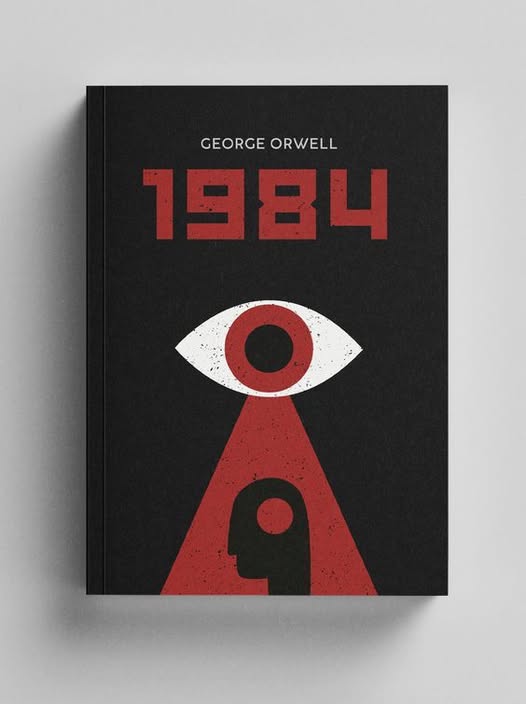
George Orwell’s 1984 remains one of the most influential dystopian novels of the twentieth century, offering a chilling vision of a totalitarian future where individuality, truth, and freedom are systematically destroyed. Published in 1949, the novel serves not only as a political warning but also as a psychological study of power, control, and human vulnerability.
At the center of the narrative is Winston Smith, a modest and disillusioned citizen of Oceania, whose quiet rebellion against the Party exposes the terrifying mechanisms through which authoritarian regimes maintain power. Orwell constructs a world dominated by surveillance, propaganda, and censorship—embodied most iconically in the figure of Big Brother, who symbolizes the omnipresence of the state. The novel’s setting is deliberately bleak, emphasizing the suffocating atmosphere in which critical thought itself becomes a punishable crime.
From a thematic perspective, 1984 explores the manipulation of truth as a political weapon. The Party’s slogan, “Who controls the past controls the future; who controls the present controls the past,” illustrates Orwell’s critique of how regimes rewrite history to legitimize their rule. This manipulation is supported by the invention of Newspeak, a reduced form of language designed to eliminate complex thought. By restricting vocabulary, the Party restricts the capacity for rebellion—an idea that reveals Orwell’s deep concern about the ties between language and freedom.
Another powerful aspect of the novel is Orwell’s exploration of psychological control. The Party does not merely seek obedience; it seeks to break the human spirit. Winston’s eventual betrayal under torture reflects Orwell’s pessimistic view of how totalitarianism can corrupt even the most determined individuals. The love story between Winston and Julia, instead of offering hope, becomes the very instrument the Party uses to destroy them. Their relationship highlights the fragility of personal connections within oppressive systems.
Stylistically, Orwell’s writing is clear, direct, and deliberate. His prose conveys a sense of mechanical bleakness that mirrors the lifeless world he depicts. Although the novel lacks the warmth or lyrical beauty found in other literary works, its strength lies in its starkness. Orwell’s plain style reinforces the realism of the dystopia; the power of the novel comes from its ideas rather than its aesthetic beauty.
From a contemporary standpoint, 1984 continues to resonate because it addresses timeless questions about privacy, government control, media manipulation, and the vulnerability of truth. In an era of mass surveillance technologies, digital propaganda, and information wars, Orwell’s warnings feel even more relevant. The novel endures not only as a literary masterpiece but also as a moral and political compass.
Ultimately, 1984 is a work that forces readers to confront uncomfortable realities about human nature and political power. Its bleakness is intentionally unsettling, urging society to remain vigilant against the slow erosion of freedom. Orwell’s message is clear: totalitarianism does not begin with violence; it begins with apathy, fear, and the abandonment of critical thought. The novel remains a necessary reminder of how precious—and fragile—freedom truly is.

