

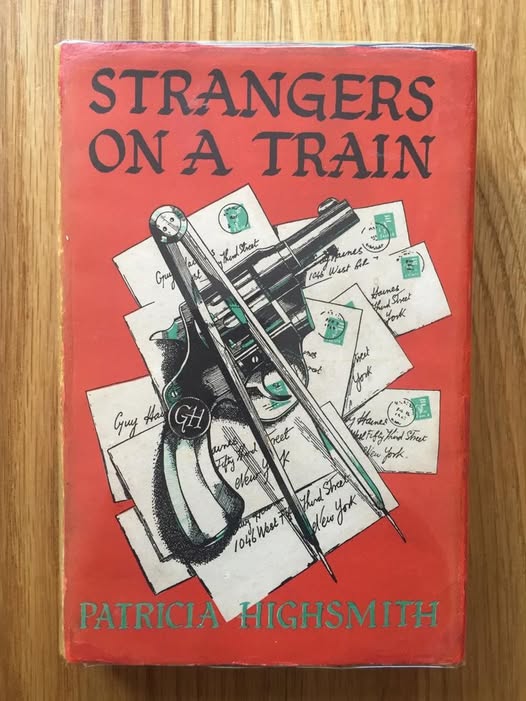
Patricia Highsmith’s Strangers on a Train (1950) is widely regarded as one of the most compelling psychological thrillers of the twentieth century. The novel introduces readers to a chilling premise built on chance, moral ambiguity, and the darkest corners of human psychology.
The story begins when two men—Guy Haines, an architect with a promising future, and Charles Bruno, a wealthy but disturbed young man—meet by coincidence on a train. What starts as an ordinary conversation slowly evolves into a dangerous proposition: Bruno suggests that they “exchange murders,” committing crimes for one another so that neither will have an obvious motive. Guy dismisses the idea as the drunken fantasy of an unstable stranger. Bruno, however, takes the conversation seriously—and the nightmare begins.
Highsmith masterfully explores the tension between guilt and innocence as Guy becomes trapped in Bruno’s obsessive manipulation. The novel delves deeply into themes of duality, moral responsibility, and the terrifying possibility that a single encounter with the wrong person can unravel an entire life. Highsmith’s precise psychological insight and slow-burn suspense create a story in which the lines between victim and accomplice blur in unsettling ways.
Strangers on a Train also stands out for its atmospheric writing and complex character development. Bruno is portrayed with an unsettling charm and unpredictability, while Guy’s inner struggle reflects the weight of ethical compromise and fear. Their intertwined fates drive the novel toward a haunting and memorable conclusion.
Celebrated both as a literary achievement and as the basis for Alfred Hitchcock’s iconic 1951 film adaptation, Highsmith’s novel remains a cornerstone of modern thriller fiction. Its exploration of human darkness and the fragility of moral boundaries continues to resonate with readers today.

