

By Max Boot
When I first visited Kyiv in May 2023, Ukraine’s capital was experiencing one of the largest air assaults of the war up to that point: Russia launched 25 missiles and nine drones. I could hear explosions outside my hotel room as Ukrainian air defenses shot down every missile. Last week, during my third visit to wartime Ukraine, Russia set another grim record by launching 30 missiles and nearly 1,000 Shahed drones within a 24-hour period (March 23–24).
The dramatic escalation in the scale of air attacks over the past three years is a sign that Russia’s war of aggression shows no sign of stopping. But Ukraine, despite being much smaller than Russia, has managed to keep pace with its aggressor. Although a drone damaged a historic church in Lviv, Ukrainian air defenses last week shot down 95 percent of Shahed drones, partly using low-cost interceptor drones not produced by any other country.
While Russia was targeting Ukrainian homes, hospitals, and churches, Ukraine was sending long-range drones to strike Russia’s oil export terminals in the Baltic Sea, more than 600 miles away.
These bold attacks have reduced Russia’s oil exports by 40 percent and, consequently, cut the oil revenues that fund Vladimir Putin’s war machine.
This may partly offset the benefits Russia gains from its war ties with Iran, which have led to rising oil prices and some easing of U.S. sanctions.
Meanwhile, Ukrainian workers have been busy repairing damage to energy infrastructure during the winter. Massive Russian missile and drone attacks had caused prolonged outages of electricity, water, and heating, as temperatures dropped to minus 4 degrees Celsius. Everyone I spoke to in Kyiv described it as the hardest winter ever. But spring has arrived, and power has been restored.
During my week in Ukraine, as part of a delegation from the nonprofit Renew Democracy Initiative, I experienced no power outages. (The organization has sent nearly $15 million in humanitarian aid to Ukraine, and I serve on its advisory board.) Both cities we visited, Kyiv and Kharkiv, remain lively and active, even though Kharkiv lies just 20 miles from the Russian border and has suffered significant damage.
During the trip, we gained fascinating insight into how this small but determined country has managed to build what may be the most powerful drone army in the world. President Volodymyr Zelensky says that 30,000 to 35,000 Russian soldiers are killed or wounded every month—more than Vladimir Putin recruits—and that 90 percent of the losses are caused by drones. In February, Ukraine even gained more territory than it lost for the first time since 2023, helped in part by disrupting Russian forces’ access to Starlink.
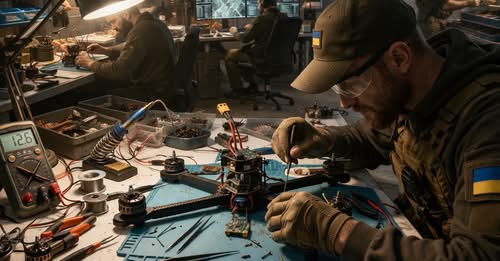
The drones that are holding back the invading forces—and that Ukraine aims to produce 7 million of this year—are built in workshops like the one we visited in an ordinary building in Kyiv, easily mistaken for an apartment or office. When you think of a factory, you imagine an automated production line in a large hangar. But in Ukraine, drones are assembled by hand, because designs change every few months based on feedback from soldiers on the front lines. Both sides are constantly innovating in an ongoing race for battlefield advantage.
Workers sit on gaming-style chairs and assemble drones at white tables. Some components—especially flight controllers, motors, and fiber-optic cables—come from China, often from the same factories that produce parts for Russian drones. Other parts are made by Ukrainian subcontractors, while some are created on-site using 3D printers.
The product line in this secret factory includes interceptor drones resembling rockets from a Tintin comic; operator-controlled kamikaze quadcopters (first-person view); and larger drones capable of dropping bombs or delivering supplies. Some are controlled via fiber-optic cables to avoid electronic interference, while others operate through radio frequencies or Starlink connections.
Each drone is tested on-site before being packaged and shipped. Without knowing what’s inside the pallets, you might think they contain Christmas toys for Walmart or Target—but in reality, they are advanced instruments of war.
A few days later, I saw how these drones are used during a visit to the 429th Unmanned Systems Brigade, known as the “Achilles” Brigade. In a field near Kharkiv, soldiers demonstrated how they use a large aerial “Vampire” drone to deliver supplies or drop bombs on Russian troops. They also showcased a ground robot called “Ardal,” a tracked platform capable of transporting supplies and evacuating the wounded.
Major Yurii Fedorenko, a 34-year-old former business executive, is the brigade’s charismatic commander. With his beard and earring, he might not fit the strict appearance standards of some American officials. But Fedorenko has been awarded Ukraine’s highest military honor, “Hero of Ukraine,” for his success in eliminating Russian invaders. Under the Ukrainian army’s point-based performance system, the achievements of the “Achilles” Brigade are rewarded with increased funding. The brigade reports that it struck nearly 38,000 targets last year and aims to hit 80,000 this year.
Fedorenko was just one of many impressive individuals I met during this visit, including business leaders, government officials, and civil activists. Their country—blessed with a well-educated population, fertile land, and abundant natural resources—will have a bright future once the war ends.
Unfortunately, no one can say when that will happen. A senior Ukrainian official told me that Putin may have been close to a deal before the war with Iran escalated. But Volodymyr Zelensky is also benefiting from the Middle East conflict. He is sending air defense specialists to the Persian Gulf and making deals with regional countries that could bring much-needed capital into Ukraine’s drone industry.
Russia is also expanding its drone production and even exporting drones to Iran, remaining a formidable adversary. But Ukrainians have one not-so-secret weapon the Russians cannot match: the determination of a democratic nation to remain free.
“After more than four years of war, most people are tired,” said Roman Andreyko, CEO of Lux Media. “We want the war to stop. We want peace. But we are not ready to surrender.” Thanks to the rapid development of its drone industry, Ukraine is not at risk of being forced to do so. / The Washington Post

